- The Qnary Newsletter
- Posts
- When Everyone Can Write Perfectly, What Makes Writing Valuable?
When Everyone Can Write Perfectly, What Makes Writing Valuable?
The answer lies in the stories only you can tell. 🐤

Theodore Krueger
December 16, 2025

Before photography existed, the value of painting was measured almost entirely by technical realism. For hundreds of years, the primary purpose of the art form was to replicate the world as accurately as possible. Commissions, careers, techniques, materials, and entire educational systems existed to recreate what the human eye saw through brush strokes.
Think of Jan van Eyck. His mastery of detail and development of oil painting was the standard of artistic excellence for many to emulate and admire. The pursuit to match his skill went on for centuries until the invention of photography, rendering the value of pure replication and van Eyck’s methods obsolete.
The camera freed painting from its role as a realistic recorder, allowing the exploration of inner worlds and subjective experiences and leading to the diverse expressions of Modernism. Artistic painting didn’t disappear, but its value and purpose changed dramatically. The shift gave rise to impressionism, post-impressionism, cubism, surrealism, and other movements in response to the disruptive tech.
Writing is now responding to its own disruptive technology, and new values are emerging as a result.

When technical realism can be achieved with one click, what new styles emerge?
The Old Standard, the “technical realism” of writing, can now be achieved through AI and LLMs.
clean grammar
competent summaries
structurally sound paragraphs
All of these can be done in seconds by anyone with access to one of many free or low-cost tools and an internet connection. This is the textual equivalent of the pre-photography realism era, and AI just invented the camera.
Technical accuracy used to be the baseline of professional writing. Many of us remember a not-too-distant past of school lessons where we parsed verbs and used a dictionary to confirm spelling and meaning. Now that work is the easiest part.
Because anyone can easily create technically accurate and relatively compelling captions or copy, we have become saturated with AI-generated “slop.” Our feeds have turned into a fine-tuned hivemind of algorithmically perfected nonsense, excellent at drawing our attention but quickly regressing into rephrased platitudes.
What it means to write and stand out on the internet has changed.
The new value layer for content is “authenticity.” Let’s break down what it really means:
lived experience
career stories and lessons
individual, unpolished writing style
photos of you out in the world
“I” statements
These are forms of knowledge AI cannot manufacture because it cannot access them. LLMs can replicate countless writing examples, but the unique qualities of the individual still remain uniquely human.
As a ghostwriter at Qnary, I’ve seen that the most substantial presence comes from sharing experiences that only the individual has. AI can scrape the internet, but it cannot scrape the story you told in a meeting or the lesson you’ll never forget from your first job.
When our customers share their photos, notes, anecdotes, and observations, they give us the raw material AI can’t access. Our writers then translate those inputs into authentic, engaging content.
Here’s one example from last month where a single insight was turned into a high-performing post.
Raw input we received:
“Contrary to the U.S. iPhone-first lens, much of the world is Android, and early WhatsApp growth owed a lot to BlackBerry. BBM primed users for always-on data messaging… ‘It’s like BBM, but it works with everyone.’ Product-market fit often arrives through adjacent habits.”
We turned that single observation into a compelling LinkedIn piece reflecting the client’s voice, leadership experience, and product intuition. No images. No video. No hashtags. Just authentic insight.
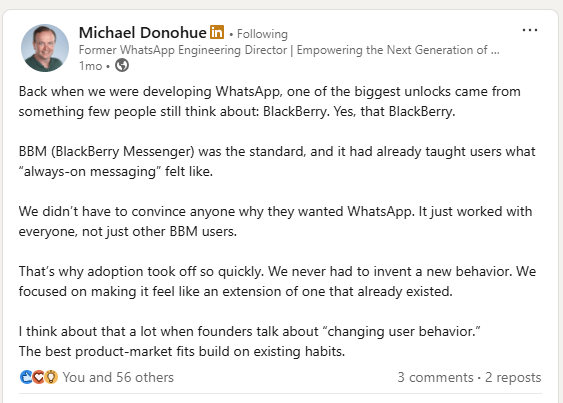
The post received 57 impressions, three comments, and two reposts. For comparison, available benchmarks from LinkedIn suggest “great” engagement for accounts with less than 5,000 followers hovers around 1%, depending on format, industry, and audience size. That makes a ~4.1% reaction rate on a 1.4k-follower profile achieved with a text-only post extremely impressive.
This post was successful because it connected a personal memory to a universal startup lesson. Subsequently, it deepened the client’s credibility by revealing how he thinks, not just what he knows.

Abstraction transformed art history. Authenticity transforms modern reputation.
This personal window into how you think will differentiate you in a sea of executive voices online.
In other words, now that we all have the capacity to be technically proficient, the aim is to translate your knowledge and experience into something unique and human. In a world full of Jan Van Eycks, you need to be Salvador Dalí.
Extend the Qnary Advantage to Another Leader
You’ve experienced how having a consistent voice online compounds into visibility, credibility, and opportunity. Now you can help another leader unlock the same momentum.
Have someone in mind? 🐤
Reach out to your Qnary Client Success Manager, and we’ll schedule an analysis of their online presence to identify their biggest opportunities.